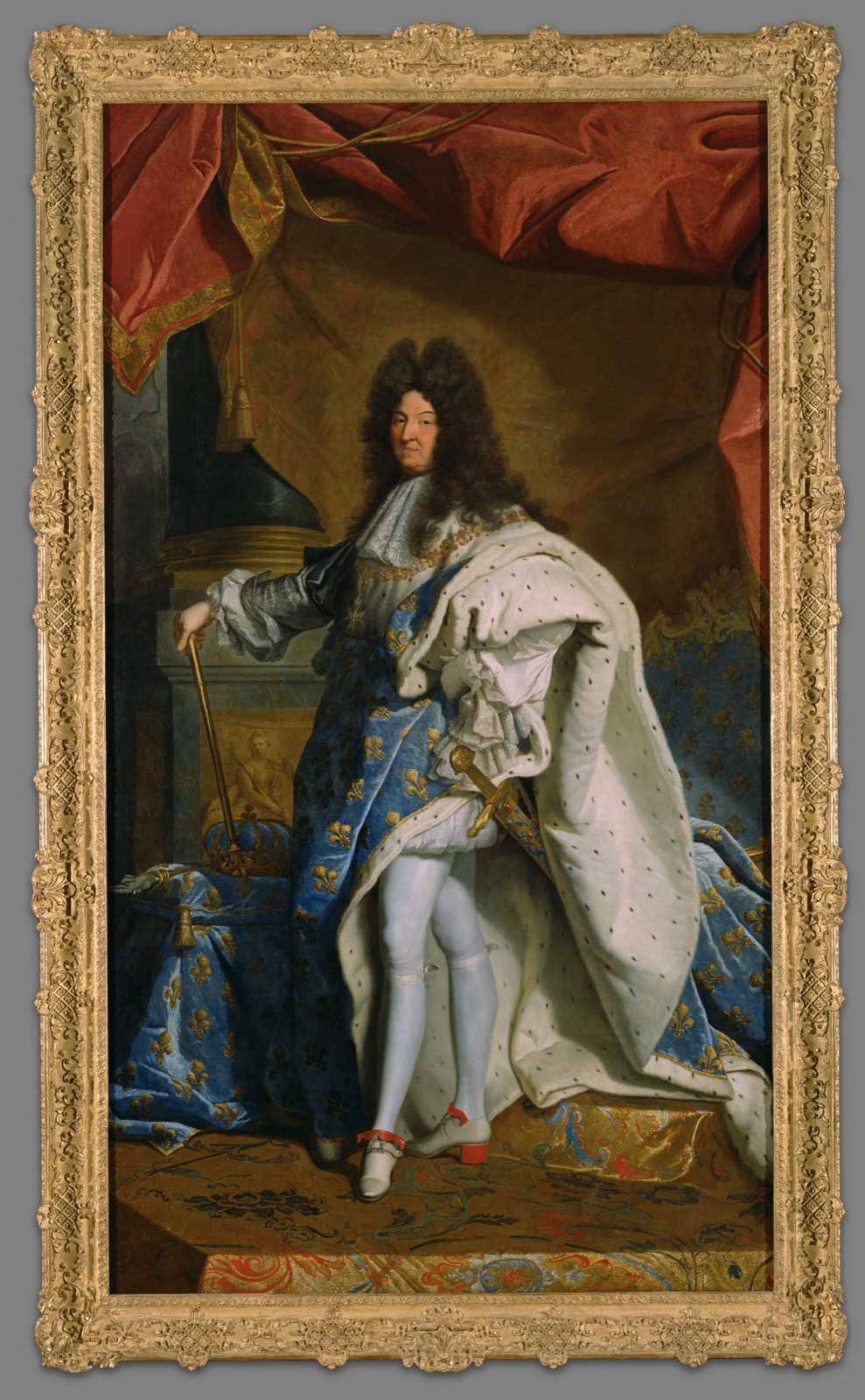
The man is wearing red heels. Lace cuffs so elaborate they constitute a second outfit. A wig that adds approximately twelve inches to his height. A velvet mantle the size of a dining table, embroidered with the entire heraldic vocabulary of France. A jeweled sword he has no intention of using.
He is 63 years old. He looks like he’s going to a party where he is also the venue.
This is Louis XIV — the Sun King, absolute monarch, architect of Versailles — in the most famous royal portrait ever painted. Hyacinthe Rigaud completed it in 1701, initially as a diplomatic gift for Louis’s grandson Philip V of Spain. Louis liked it so much he kept it and sent Philip a copy. A reasonable decision. It is an extraordinary piece of work. It is also, if you approach it without warning, an extremely funny outfit.
But here’s what the outfit actually is: the single most carefully engineered image of masculine authority produced in the early modern period. Every piece is doing political work. Every choice — the wig, the lace, the legs, the heels, the sword, the mantle — carries a specific argument about power, rank, and the nature of kingship. Rigaud didn’t paint what Louis XIV looked like. He painted what Louis XIV meant.
The Wig
Louis had started going bald in his twenties. The periwig — that cascade of dark curls tumbling past his shoulders — solved the cosmetic problem and replaced it with something considerably more useful: a frame that made him enormous.
At Versailles, wig size tracked rank with the precision of a dress code. Courtiers knew exactly where they stood in the hierarchy by measuring theirs against the king’s, and his was always the biggest in the room. The wig didn’t just cover vulnerability. It converted it into grandeur. By the end of Louis’s reign, the periwig had spread across every court in Europe. Heads of state from Madrid to Vienna were wearing variations on the same architectural choice. Louis had exported his aesthetic solution to baldness and turned it into the visual grammar of European power for half a century.
The Lace
The cuffs deserve their own sentence: those are not decorative. That is Point de France lace, and it cost more than most people in seventeenth-century France earned in a year.
In the 1660s, French aristocrats were spending ruinous sums on imported Venetian and Flemish needle lace, draining the national economy into foreign workshops. Louis’s finance minister Colbert identified this as a structural problem and fixed it by, essentially, inventing a French luxury industry. He recruited foreign lacemakers, established royal workshops, imposed import bans, and named the resulting product Point de France — French stitch — so that wearing it was an act of national allegiance as much as personal taste.
By the time Rigaud painted Louis, wearing this lace announced something precise: I patronize French industry, I set French taste, I control what refinement looks like in this country. The impracticality of the cuffs — they would not survive any contact with actual labor — was the entire message. Louis was not going to do dishes. Louis was not going to do anything that would endanger the lace. The lace was proof that such concerns were beneath him.
The Legs
He is showing his legs. In a formal state portrait. Deliberately.
Louis was a serious ballet dancer — trained from childhood, performed in court entertainments into his thirties. He was proud of his legs in the way serious athletes are proud of the physical evidence of their work, and the fashion of his court reflected this: breeches cut to mid-thigh, silk stockings drawn tight, the lower body put prominently on display. In the Rigaud portrait the pale blue-grey legs occupy a significant portion of the canvas. They are not incidental. Rigaud has composed the image so they read clearly, the stance wide and grounded, the posture of someone who takes up space without apology.
Exposed legs in seventeenth-century portraiture carried a specific coding: masculine vigor, physical command, the suggestion of a body capable of more than sitting on a throne. The legs were résumé. They said: this man was trained, disciplined, physically present in his own authority. The ermine and velvet said he no longer needed to prove it. The legs said he could, if he had to.
The Red Heels
In the early 1670s, Louis made it known that only a select group of noblemen were permitted to wear red heels — the talons rouges — at court. The shoes became a coveted badge of honor. You weren’t wearing footwear. You were wearing documented proximity to the king.
The heels in the Rigaud portrait are red. They catch the eye before almost anything else. This is correct. They were designed to.
The logic is elegant in its brutality: impracticality signals privilege. High heels are difficult to walk in, impossible to run in, and completely unsuitable for any form of productive labor. Wearing them said, with the authority of a royal decree behind it, that the wearer did not walk — they processed. That they had people to do the practical things. That their relationship to the physical world was mediated entirely by their relationship to power.
Louis wore the highest heels in the room. He wore them in portraits that would be copied and circulated across Europe. He wore them while running an absolute monarchy from a palace he’d spent decades building specifically to demonstrate what absolute monarchy looked like. The heels were not vanity. They were policy.
The Sword
The sword is jeweled. It is not a functional weapon. It is an argument.
The argument goes: I descend from a line of warrior kings who won and held this territory by force. The legitimacy of the Bourbon dynasty rests on that history. I am the inheritor of that force. And now look at what I have done with it — I have turned it into jewelry.
Rigaud positions the sword at Louis’s hip, visible but at rest, the hand resting near the pommel without gripping it. The posture is not threatening. It is the posture of a man who has already won. The sword’s presence says the violence is available; everything else in the portrait says it hasn’t been necessary for some time, and the person who made it unnecessary is standing in front of you in red heels and lace cuffs, looking perfectly at ease.
The Mantle
Everything else in the portrait is a piece of clothing. The mantle is France.
It is made of white velvet lined with ermine — a fur that was, by law and long precedent, restricted to royalty. Scattered across the surface, rendered in gold: fleurs-de-lis, the heraldic emblem of the Capetian dynasty, the family that had ruled France in one form or another since 987. The mantle doesn’t drape over Louis so much as it engulfs the lower third of the canvas, pooling at his feet, so voluminous that it requires the carved chair to the right just to hold its weight.
You cannot separate Louis XIV from the mantle. You cannot separate the mantle from the fleurs-de-lis. You cannot separate the fleurs-de-lis from the dynastic history of France. Rigaud has constructed a visual argument in which the man and the state are literally the same object, wrapped in the same fabric, inseparable in the frame.
L’état, c’est moi. I am the state. Louis is reported to have said this, though historians debate whether he actually did. It doesn’t matter. Rigaud painted it, and the painting has been hanging in the Louvre for three centuries making the case.
What Rigaud Actually Painted
Rigaud was not a court flatterer. He was a technically brilliant portraitist working in a tradition that understood portraiture as rhetoric — a form of argument made in oil paint, designed to persuade a viewer of a specific set of claims about its subject.
The claims here are: Louis XIV is physically commanding. He is culturally dominant — he sets the aesthetic standards that others follow. He is economically supreme — he controls the industries that produce the symbols of refinement. He is dynastically legitimate — he wears the emblems of a thousand years of French royal history. He is militarily unchallengeable — the sword is there, resting, patient. And he is divine — the composition places him like a saint in an altarpiece, the curtains parting behind him like clouds.
All of this is communicated through clothing.
This is the part that tends to stop people: not that a king would want to project power, but that fabric and footwear were sufficient instruments to do it. The wig, the lace, the heels, the sword, the mantle — none of these required Louis to do anything. They required Louis to be seen. The portrait was the medium. The outfit was the message. Versailles, with its fifteen hundred rooms and its Hall of Mirrors and its capacity to house the entire French court, was the context that made both legible.
Louis XIV understood that power at the scale he was exercising it could not be performed in actions alone. It had to be performed in images, in aesthetics, in the daily visual theater of a court that he controlled down to the color of the heels. He turned fashion into governance, and he did it so effectively that historians still call the seventeenth century in Europe the Age of Louis XIV — as if the whole period was dressed by one man.
Look at the portrait again. The wig. The lace. The legs. The heels. The sword. The mantle.
Not a costume. Masculine power dressing. The most influential fit in Western history, worn by a man who understood that how you look and what you mean can be, if you’re very deliberate about it, exactly the same thing.
What Do You Think?
Which part of Louis XIV's outfit is doing the most political work? Share your thoughts in the comments.