
Most ships sold for scrap do not receive a sunset. They receive a buyer, a towing schedule, and men waiting at the other end with saws.
HMS Temeraire was no different, until J.M.W. Turner intervened.
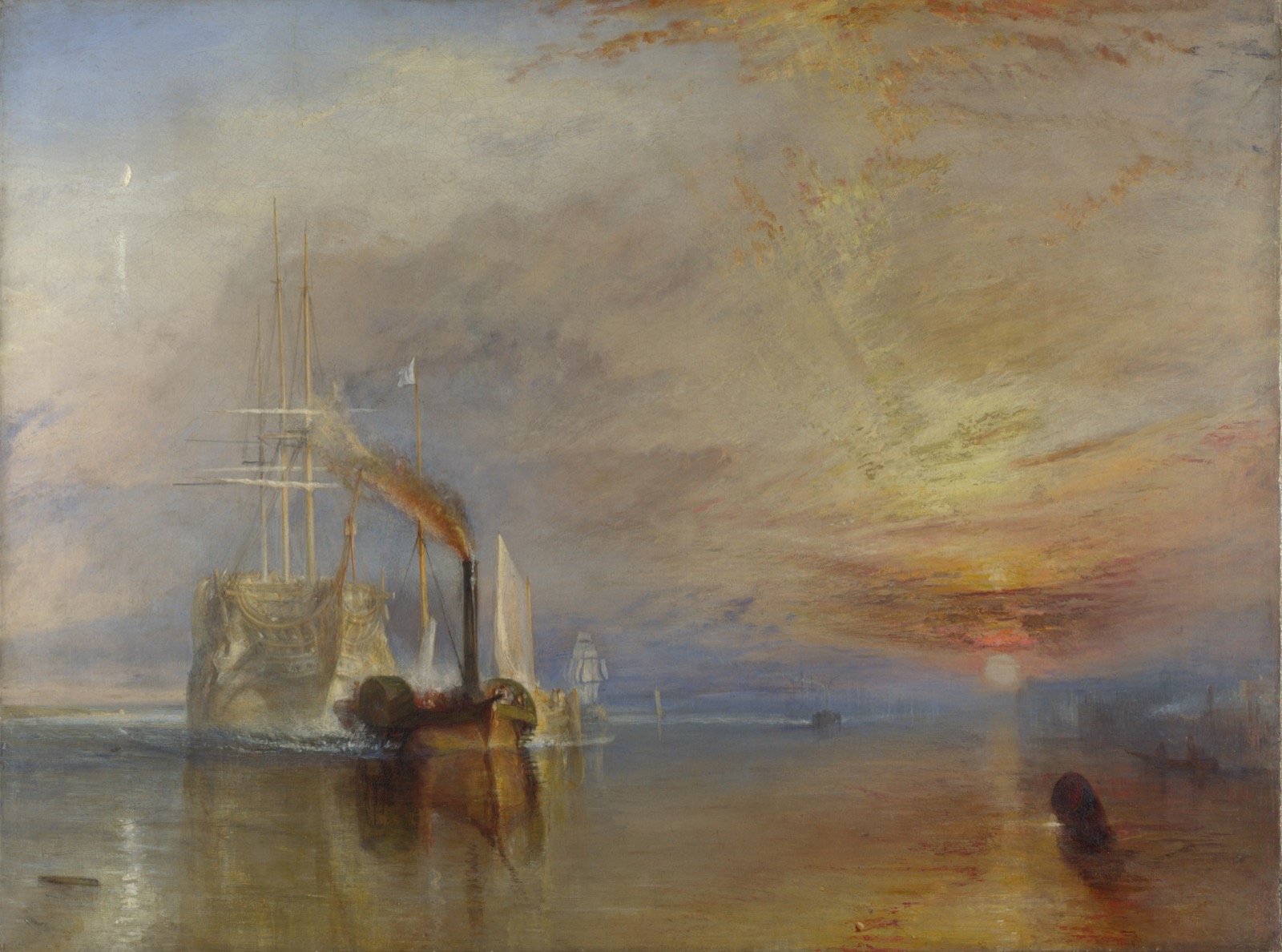
In The Fighting Temeraire tugged to her last berth to be broken up, the old warship glides across the Thames in ghostly white and gold. Her masts still rise into the sky, although her sails are furled and her movement belongs entirely to the steam tug churning ahead. Behind them, the sun appears to be setting on the ship, the river, and the Age of Sail.
Turner was in his sixties, deep into a career built over forty years of exhibiting at the Royal Academy. That career had reached its own late stage, the way the ship in front of him had reached hers. It isn’t hard to see why people look at an old ship being quietly retired and think of an old painter doing the same. This painting has long been read as a kind of self-portrait.
It is an extraordinarily persuasive farewell. It is also almost entirely Turner’s invention.
The Actual Retirement Was Less Cinematic
The Temeraire had earned her reputation honestly. At Trafalgar in 1805, she fought immediately behind Nelson’s Victory, engaging two French ships and helping protect the flagship. It was the only battle she ever fought, but one spectacular day was enough to secure her place in history.
What followed was considerably less suitable for a national epic. She became a prison ship in 1812, and later served as a receiving and depot ship at Sheerness. By the time the Admiralty sold her in 1838, she had remained moored there for eighteen years, fading in plain sight for nearly two decades.
Before the auction, Navy work crews removed everything reusable, including her guns, anchors, masts, yards, and rigging. John Beatson, a Rotherhithe shipbreaker and timber merchant, bought the resulting 2,110-ton wooden shell for £5,530 in August 1838.
(Worth remembering that number.)
Beatson hired two steam tugs to move her up the Thames. The journey took two days, departing Sheerness on September 5th and reaching his wharf the following afternoon. It’s unknown if Turner witnessed any part of the journey himself.
That gave him considerable freedom over the weather.
Turner Puts the Ship Back Together
Turner restored her masts, her rigging, and her furled sails. She still cannot move under her own power, but she has been allowed to arrive at the breaker’s yard dressed as a warship. He also redesigned the tug itself. He placed its funnel in front of its mast, reversing the usual arrangement, so the smoke pours backward through the Temeraire’s rigging. When an engraver later “corrected” the design for a print, Turner was reportedly furious.
His liberties extended to the sky, too. In truth the sun would have set ahead of her, not behind as Turner painted. She’d arrived hours before sunset anyway, in the plain light of an ordinary afternoon. He gave her one anyway, along with a delicate crescent moon, though the real moon that night would have been far fuller. And there’s a smaller, quieter change easy to miss entirely: the Temeraire no longer flies the Union flag. Once sold out of the Navy, she’d legally stopped being naval property, and Turner recorded that fact precisely — while giving the tug a prominent white commercial flag of its own, so the absence reads as loss rather than oversight. He cared enough about this one detail that he wrote it into the poetry he exhibited alongside the painting, adapting a line from Thomas Campbell’s “Ye Mariners of England” and adding a second line of his own:
“The flag which braved the battle and the breeze,
No longer owns her.”
The first line was Campbell’s. The second was Turner’s.
The ship, the tug, the sun, the moon, and even her flag have all been adjusted. Turner was not simply recording the Temeraire’s final journey. He was eulogizing it.
The Tug Is Not Necessarily the Villain
It’s tempting to read the painting as a contrast between noble sail and ugly steam, a visual diatribe on the expanding industrialization. Contemporary critics certainly did. William Makepeace Thackeray, reviewing the 1839 exhibition, wrote that the Temeraire was “dragged to her last home by a little, spiteful, diabolical steamer.”
Turner’s own position looks more complicated than that. He traveled regularly by steamboat and painted the machinery of modern life elsewhere without contempt. His tug here is dark and forceful, but not visually worthless — the same light that turns the Temeraire gold also catches the tug’s smoke, funnel, and churning wake. The tug may represent the force replacing the old ship, but it’s also the only thing keeping her moving. Steam hasn’t wandered into the painting to murder the age of sail, it’s carrying that age to its final berth.
The Painting That Wasn’t for Sale
Turner was sixty-four when the painting appeared at the Royal Academy. By then, he’d spent nearly forty years returning to the rise and fall of empires — he painted around ten major works on the decline of Carthage alone, using the same device of a setting sun more than two decades before he used it on the Temeraire. The theme had preoccupied him for most of his career, long before any one ship or any one ending gave him a reason to think about his own.
He was equally deliberate about the survival of his own work. In his 1831 will, Turner specified that Dido Building Carthage and Sun Rising through Vapour should hang “in perpetuity” in the National Gallery, beside two named paintings by Claude. He wasn’t leaving posterity to decide where he belonged. He’d already selected the wall.
This is why the familiar self-portrait reading of the Temeraire stays tempting, even though Turner never wrote that the ship represented him. He took an aging subject whose greatest achievement was decades behind her, and rebuilt her ending until it could carry the full weight of the reputation that came before it.
Then he kept the painting.
That wasn’t a financially trivial choice. Turner sold several major late oils for hundreds of pounds each. In 1845, the American collector James Lenox bought Staffa, Fingal’s Cave from him for £500. The Temeraire itself he wouldn’t even lend out twice. He’d allowed a print publisher to borrow it once, in 1844; when someone tried to borrow it again a few years later, he refused outright, writing: “No considerations of money or favour can induce me to lend my Darling again.” By 1848, Lenox came back with something bigger: not a loan this time, but an offer to buy the painting outright, first for £5,000, then, when that was turned down, a blank cheque. Turner said no to that too. He’d already decided where it belonged.
£5,000 – or in today’s money, about $1 million USD. The H.M.S. Temeraire herself had sold for just slightly more than that. The Admiralty sent its Temeraire to Rotherhithe. Turner kept his intact, and left her to the nation.
What Do You Think?
Share your thoughts in the comments.